
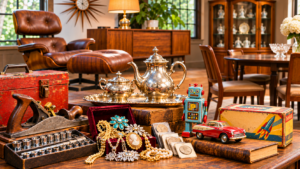
What Sells (and What Doesn’t) at Estate Sales in North Georgia
Every family preparing for a sale has a mental list of the valuable items. The formal dining set. The china. The curio cabinet full of
A Premier Estate Liquidation, Estate Auction & Estate Services Company

Maybe you inherited a house full of furniture, or maybe you have been collecting for decades and are ready to let some pieces go. Either way, knowing how to sell antiques well comes down to three things: understanding what you have, knowing what it is worth in today’s market, and choosing the right place to sell it. This guide covers each step, along with the mistakes that cost sellers the most money.
Before you can price anything, you need to know what it is. Start by gathering whatever information the piece will give you:
COLLECTOR TIP
Do not clean, polish, or refinish an antique before having it evaluated. Stripping original finish from furniture or polishing the patina off bronze and silver can significantly lower what a collector will pay.
Age alone does not make something valuable. Demand does. Many pieces that were expensive when new, such as formal dining sets, china cabinets, and collector plates, now sell for far less than families expect. Meanwhile, mid-century furniture, quality tools, signed costume jewelry, and certain vintage kitchenware are in strong demand. Our guide to what sells (and what doesn’t) at estate sales in North Georgia covers the current market in more detail.
When researching values online, look at completed sales, not asking prices. A listing that has sat unsold for months tells you what someone hoped to get, not what buyers will pay.
For anything you suspect has significant value, or when an estate needs to be divided fairly among heirs, a professional opinion is worth it. A knowledgeable estate professional sees what sells week after week and can tell you not just what a piece is, but what it will realistically bring. Yellow Bird offers an online appraisal form where you can submit photos, as well as in-home valuation of assets for larger collections and full households.
The right selling channel depends on what you have, how much of it there is, and how much time and effort you want to put in.
Best for a full household with a mix of antiques and everyday goods. A professionally run estate sale draws dealers, collectors, and local shoppers, and the team handles pricing, staging, and selling everything in the home.
Best for collectible and specialty pieces that benefit from a wider audience. With an online estate auction, bidders compete for each item, which can push prices up for desirable antiques. Not sure which format fits? See estate sale vs. auction.
Good for a few select, higher-end pieces when you are not in a hurry. The item is displayed and sold for you, and you receive a share of the sale price. Learn more about Yellow Bird consignment.
The fastest option, but usually the lowest return. Dealers need room to resell at a profit, so expect offers below retail value. This can make sense for a quick sale of a single item.
Marketplace sites and online platforms put you in control of price, but you also take on photography, listing, buyer messages, payment, and shipping or pickup. Large furniture is especially difficult to sell this way.
ESTATE SALE INSIGHT
If you are selling an entire household, pulling the best antiques out to sell separately can backfire. Standout pieces are what bring serious buyers to a sale, and the rest of the household often sells better because of them. Talk with your estate sale company before splitting things up.
It depends on the item and the quantity. Full households usually do best at an estate sale. Collectible and specialty pieces often bring more at online auction, where more buyers compete. A few high-end items can work well on consignment.
Look for maker’s marks, check completed sales of similar items, and consider condition and current demand. For anything you are unsure about, a professional appraisal is the most reliable answer.
Some is, and some is not. Mid-century modern and well-made pieces in lighter styles are in demand. Large, dark, formal furniture has softened in value, though it still sells, often at a more modest price.
A light dusting is fine, but avoid polishing, stripping, or refinishing until a professional has seen the piece. Original finish and patina are often part of what collectors are paying for.
Since 2010, Yellow Bird has helped North Georgia families and collectors sell antiques through estate sales, online auctions, and consignment, with a network that includes auction houses, antique dealers, collectors, and design firms. We serve Cumming, Dawsonville, Gainesville, Alpharetta, Buford, Dahlonega, Cleveland, Johns Creek, and much of Metro Atlanta. Call 770-402-5185, submit photos for appraisal, or schedule a free consultation.
Every family preparing for a sale has a mental list of the valuable items. The formal dining set. The china. The curio cabinet full of

Have you ever opened a closet, pulled out a dusty box, and wondered, “Why on earth have I kept this all these years?” Maybe it’s